

TL;DR
- Software license management software automates tracking, compliance, and optimization of software licenses across an organization
- Key features include automated discovery, license reconciliation, compliance reporting, renewal management, and cost optimization
- Organizations achieve 20-30% cost savings through license optimization and reduced compliance risk
- Manual license management creates audit risks, overspending, and compliance gaps
- Selection criteria include integration capabilities, automation features, reporting depth, and vendor support
Software license management software is a centralized platform that tracks, controls, and optimizes software licenses across an organization to ensure compliance, reduce costs, and maintain an accurate inventory of all software assets.
What Is Software License Management Software and Why Organizations Need It
Software license management software provides automated oversight of all software licenses within an organization. The platform tracks license entitlements, installations, usage patterns, and compliance status in real time.
Organizations face increasing complexity in managing software licenses. The average enterprise uses 250-300 different software applications, each with distinct licensing models, terms, and renewal dates. Without dedicated software license management software, IT teams rely on spreadsheets, manual audits, and reactive vendor inquiries.

Core capabilities of software license management software include:
- Automated software discovery and inventory across all endpoints
- License entitlement tracking and reconciliation
- Compliance monitoring and audit readiness
- Cost optimization and license harvesting
- Renewal management and expiration alerts
- Usage analytics and optimization recommendations
The business case for software license management software centers on risk reduction and cost control. Software audits by vendors like Microsoft, Oracle, and Adobe result in average penalties of $200,000-$4.5 million for non-compliance. Organizations also waste 20-30% of their software budget on unused or underutilized licenses.
Manual tracking creates gaps in visibility. Spreadsheets become outdated within days as employees install software, leave the organization, or change roles. Software license management software maintains continuous, automated accuracy.
What Features Should Software License Management Software Include
Effective software license management software delivers specific capabilities that address compliance, cost control, and operational efficiency.
Automated Discovery and Inventory
The foundation of license management is knowing what software exists in your environment. Software license management software deploys agents or agentless scanning to identify all installed applications across workstations, servers, virtual machines, and cloud instances.
Discovery runs on scheduled intervals (daily, weekly) to maintain current inventory. The system catalogs application names, versions, publishers, installation dates, and associated users. Advanced platforms detect unauthorized or shadow IT installations.
License Reconciliation and Compliance Tracking
Reconciliation compares discovered installations against purchased entitlements. Software license management software maps license types (perpetual, subscription, concurrent, named user) to actual deployments.
The system identifies:
- Over-deployed licenses exceeding purchased quantities
- Under-utilized licenses available for reallocation
- Non-compliant installations requiring remediation
- Licenses approaching expiration
Compliance dashboards provide real-time visibility into license position by vendor, department, or application. Automated alerts notify administrators of compliance risks before vendor audits occur.
Usage Analytics and Optimization
Software license management software tracks application usage patterns to identify optimization opportunities. The platform monitors login frequency, feature utilization, and session duration.
| Usage Pattern | Action | Savings Potential |
|---|---|---|
| Never used (90+ days) | Harvest and reallocate | 15-20% of license costs |
| Infrequent use (<5 times/month) | Downgrade or share | 10-15% of license costs |
| Power users requiring advanced features | Upgrade to appropriate tier | Reduced compliance risk |
| Duplicate functionality across tools | Consolidate to single platform | 20-25% of category spend |
Organizations using software asset management software gain visibility into these patterns and execute data-driven optimization strategies.
Renewal Management and Lifecycle Tracking
Software license management software automates renewal workflows. The platform tracks maintenance agreements, subscription end dates, and true-up periods. Administrators receive advance notifications (90, 60, 30 days) before renewals.
Renewal management includes:
- Centralized calendar of all renewal dates
- Automated vendor notification and quote requests
- Historical pricing and terms for negotiation leverage
- Budget forecasting based on upcoming renewals
- Approval workflows for procurement authorization
Integration and Workflow Automation
Enterprise software license management software integrates with existing IT systems. Common integrations include:
- Configuration Management Databases (CMDB): Synchronize software inventory with hardware assets
- IT Service Management (ITSM): Automate license requests and approvals through service desk tickets
- Procurement Systems: Connect purchase orders to license entitlements
- Identity Management: Link licenses to user accounts for accurate allocation
- Financial Systems: Export cost data for chargeback and budgeting
Custom software development teams can extend these integrations. Brytend builds tailored connectors between software license management software and proprietary internal systems, enabling seamless data flow and automated workflows specific to organizational requirements.

How Does Manual License Management Compare to Automated Software
Manual license management relies on spreadsheets, email correspondence, and periodic physical audits. This approach creates significant operational and financial risks.
Manual License Management Process
Organizations using manual methods follow this workflow:
- IT administrator receives software purchase approval
- License details recorded in spreadsheet (vendor, quantity, purchase date, cost)
- Installation tracked through email requests or help desk tickets
- Periodic (quarterly/annual) manual inventory conducted
- License counts reconciled against spreadsheet records
- Vendor invoices reviewed manually for renewals
Limitations of manual license management:
- Time consumption: IT staff spend 10-20 hours monthly on license administration
- Data accuracy: Spreadsheets become outdated within days of updates
- Compliance gaps: Manual audits miss installations between review periods
- No usage visibility: Cannot determine which licenses are actively used
- Reactive renewals: Renewals discovered through vendor invoices, not proactive planning
- Audit risk: Incomplete records create vulnerability during vendor audits
- Cost waste: No systematic identification of unused licenses
Automated Software License Management Software
Software license management software transforms these processes through automation and continuous monitoring.
| Process | Manual Approach | Automated Approach | Time Savings |
|---|---|---|---|
| Software discovery | Quarterly manual audit | Real-time automated scanning | 95% reduction |
| License reconciliation | Monthly spreadsheet review | Continuous automated comparison | 90% reduction |
| Compliance reporting | Ad-hoc manual compilation | On-demand automated dashboards | 85% reduction |
| Renewal tracking | Calendar reminders | Automated alerts and workflows | 80% reduction |
| Usage analysis | Not performed | Continuous automated monitoring | New capability |
The ROI of software license management software typically materializes within 6-12 months. Organizations with 500+ employees recoup implementation costs through:
- 20-30% reduction in software spending through optimization
- $150,000-$500,000 avoided audit penalties
- 50-70% reduction in administrative time
- Elimination of emergency purchase orders for forgotten renewals
What Are Common Mistakes When Implementing Software License Management Software
Organizations encounter predictable challenges during software license management software implementation. Understanding these mistakes enables proactive mitigation.
Incomplete Scope Definition
The most common mistake is limiting software license management software to specific vendors or applications. Organizations often start with high-cost publishers (Microsoft, Adobe, Autodesk) but exclude smaller vendors or open-source tools with commercial components.
Best practice: Include all software in scope from initial deployment. Even free applications may have premium features, support contracts, or compliance requirements. Comprehensive coverage prevents gaps that emerge during vendor audits.
Insufficient Data Cleanup Before Implementation
Software license management software inherits existing data quality issues. Organizations with incomplete purchase records, missing license keys, or uncertain entitlement counts struggle to establish accurate baselines.
Pre-implementation steps:
- Consolidate all license purchase records into centralized repository
- Contact vendors to confirm current entitlements and license counts
- Document licensing models and terms for each application
- Identify and categorize all software-related contracts
- Establish naming conventions and data standards
Lack of Process Integration
Software license management software requires process changes. Organizations that deploy the tool without updating procurement, onboarding, and offboarding workflows miss critical license events.
Required process updates:
- Procurement: All software purchases flow through software license management software for tracking
- Employee onboarding: License assignments automated through identity management integration
- Employee offboarding: License reclamation triggered automatically when accounts are disabled
- Software requests: Approval workflows check license availability before new installations
Companies managing complex task and project management software implementations benefit from structured change management approaches.
Inadequate Stakeholder Engagement
Software license management software affects multiple departments: IT, procurement, finance, legal, and end users. Implementations that exclude these stakeholders face resistance and adoption challenges.
Stakeholder communication plan:
- IT Operations: Training on platform features, reporting, and workflows
- Procurement: Integration with purchasing systems and approval processes
- Finance: Cost allocation, budgeting, and chargeback reporting requirements
- Legal: Compliance reporting and audit response procedures
- End Users: Self-service capabilities and license request processes
Neglecting Ongoing Maintenance
Software license management software requires continuous attention. Organizations that treat implementation as one-time projects experience data decay and diminishing ROI.
Ongoing maintenance activities:
- Monthly review of compliance dashboards and remediation of issues
- Quarterly optimization reviews to identify harvesting opportunities
- Semi-annual process audits to ensure workflows remain effective
- Annual strategic review of software portfolio and rationalization opportunities
- Continuous platform updates and integration maintenance
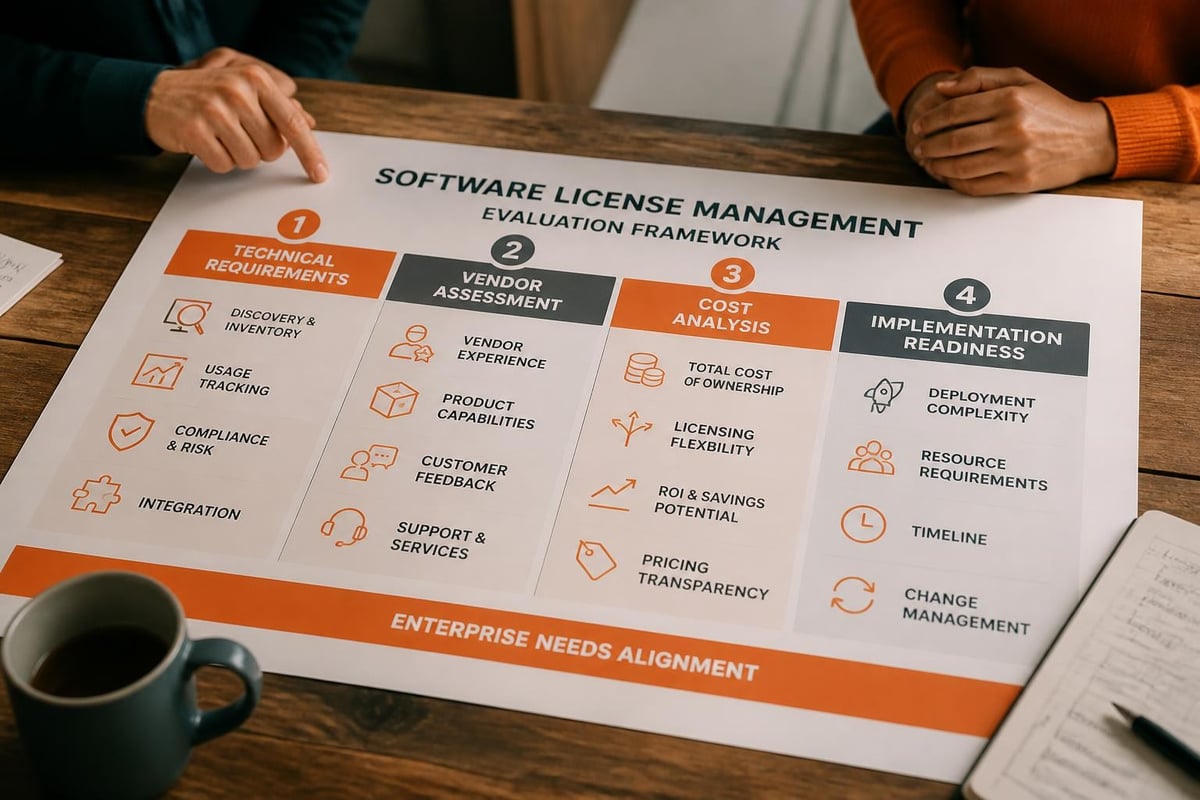
How Do You Select the Right Software License Management Software
Selecting software license management software requires evaluating technical capabilities, vendor stability, and organizational fit.
Assessment Criteria Framework
Organizations should evaluate platforms across six dimensions:
1. Discovery Capabilities
- Agent-based vs. agentless scanning options
- Coverage of on-premises, cloud, and mobile environments
- Accuracy of application recognition and versioning
- Performance impact on endpoints during scanning
- Frequency of discovery scans
2. License Compliance Features
- Support for diverse licensing models (named user, concurrent, processor-based, subscription)
- Vendor-specific rule libraries (Microsoft, Oracle, Adobe, etc.)
- Custom licensing rule creation for proprietary agreements
- Compliance reporting depth and customization
- Audit preparation and evidence collection tools
3. Optimization and Analytics
- Usage tracking granularity and historical data retention
- Optimization recommendation engine capabilities
- Cost allocation and chargeback reporting
- ROI tracking and savings documentation
- Forecasting and what-if scenario modeling
4. Integration and Automation
- Pre-built connectors for common IT systems
- API availability and documentation quality
- Workflow automation capabilities
- Data export formats and scheduling
- Identity management integration
5. Vendor Evaluation
- Market presence and customer base size
- Financial stability and acquisition history
- Product roadmap and innovation track record
- Customer support model and response times
- User community and knowledge base resources
6. Implementation and Scalability
- Deployment complexity and timeline
- Training requirements and available resources
- Scalability to support organizational growth
- Multi-tenancy for subsidiary or division management
- Total cost of ownership (licensing, maintenance, support)
Evaluation Process Steps
Follow this structured approach to software license management software selection:
- Requirements definition (2-3 weeks): Document current environment, compliance requirements, integration needs, and success metrics
- Market research (2 weeks): Identify 6-8 vendors meeting basic requirements through analyst reports and peer references
- RFP process (4-6 weeks): Issue detailed requirements to vendors and evaluate written responses
- Product demonstrations (3-4 weeks): Conduct demos with top 3-4 vendors using real organizational data
- Proof of concept (4-6 weeks): Deploy finalist solutions in limited production environment to validate capabilities
- Reference checks (2 weeks): Interview 3-5 customers of finalist vendors with similar environments
- Commercial negotiation (2-4 weeks): Negotiate pricing, terms, and support agreements
- Final selection and approval (1-2 weeks): Present recommendation to decision-makers and obtain approval
Implementation Best Practices
Successful software license management software implementations follow structured approaches:
Phase 1: Foundation (Weeks 1-4)
- Install and configure core platform
- Establish data connections to existing systems
- Configure initial discovery scans
- Import known license entitlements
Phase 2: Baseline (Weeks 5-8)
- Complete comprehensive software discovery
- Reconcile discovered installations with entitlements
- Document compliance gaps and remediation priorities
- Establish baseline metrics for optimization
Phase 3: Process Integration (Weeks 9-12)
- Deploy approval workflows
- Configure automated alerts and notifications
- Integrate with procurement and ITSM systems
- Train IT staff and administrators
Phase 4: Optimization (Weeks 13-16)
- Launch usage tracking and analysis
- Identify initial optimization opportunities
- Execute license harvesting and reallocation
- Document cost savings and ROI
Organizations implementing field service management software or other complex platforms benefit from similar phased approaches.
What ROI Can Organizations Expect from Software License Management Software
Software license management software delivers measurable financial and operational returns. Organizations track ROI across multiple categories.
Direct Cost Savings
The primary ROI driver is reduced software spending through optimization and compliance.
License optimization savings:
- Harvesting unused licenses: 15-20% reduction in total software costs
- Right-sizing license tiers: 10-15% savings through appropriate SKU selection
- Consolidating duplicate functionality: 20-25% savings in specific categories
- Negotiation leverage: 5-10% better renewal pricing through usage data
Example: A 2,000-employee organization with $5 million annual software spend typically realizes $750,000-$1.2 million in annual savings through systematic optimization.
Avoided Compliance Costs
Software vendor audits result in significant financial penalties for non-compliance. Software license management software dramatically reduces audit risk.
| Vendor | Average Audit Penalty | Prevention Value |
|---|---|---|
| Microsoft | $500,000-$2 million | Continuous compliance monitoring |
| Oracle | $1 million-$5 million | Processor-based license tracking |
| Adobe | $200,000-$800,000 | Named user reconciliation |
| IBM | $750,000-$3 million | Sub-capacity reporting automation |
| Autodesk | $300,000-$1.2 million | Network license optimization |
Organizations facing audit typically invest 200-500 hours in evidence collection and response. Software license management software reduces this to 20-50 hours through automated reporting and documentation.
Operational Efficiency Gains
Automation reduces administrative burden on IT staff.
Time savings by activity:
- Software discovery: 40 hours/month reduced to 2 hours/month
- License reconciliation: 20 hours/month reduced to 2 hours/month
- Compliance reporting: 15 hours/month reduced to 1 hour/month
- Renewal processing: 10 hours/month reduced to 2 hours/month
At $75/hour loaded IT cost, these reductions deliver $60,000-$75,000 annual labor savings for mid-sized organizations.
Risk Reduction Benefits
Software license management software mitigates several operational risks beyond financial penalties:
- Security risk: Identifies unauthorized software installations that may introduce vulnerabilities
- Business continuity: Prevents service disruptions from expired licenses
- Vendor relationship: Maintains positive vendor relationships through demonstrated compliance
- Audit preparedness: Reduces business disruption during vendor audits
While difficult to quantify precisely, organizations value these risk reductions at 1.5-2x the direct cost savings.
Total ROI Calculation
For a 2,000-employee organization with $5 million annual software spend:
Annual Benefits:
- License optimization savings: $900,000
- Avoided audit penalties (amortized): $150,000
- Operational efficiency gains: $70,000
- Total Annual Benefit: $1,120,000
Annual Costs:
- Software license management software licensing: $100,000
- Implementation and training (amortized): $40,000
- Ongoing administration: $30,000
- Total Annual Cost: $170,000
Net Annual ROI: $950,000 (559% return)
Most organizations achieve payback within 6-12 months of implementation.
Software license management software transforms reactive, manual license tracking into proactive, automated compliance and cost optimization. Organizations implementing these platforms achieve measurable ROI through reduced spending, avoided penalties, and operational efficiency while maintaining continuous audit readiness. Whether managing complex multi-vendor environments or scaling rapidly, the right software license management software provides visibility and control essential for modern IT operations. Brytend develops custom software solutions that integrate with license management platforms, extending capabilities to match unique organizational workflows and delivering tailored automation that maximizes the value of your license management investment.