Software asset management software is a specialized platform that automates the discovery, inventory, tracking, and optimization of software licenses across an organization's IT infrastructure. Organizations use these tools to maintain compliance with vendor agreements, eliminate waste from unused licenses, and reduce audit risk. In 2026, the shift to cloud-based SaaS subscriptions and hybrid environments has made manual tracking impossible for most enterprises.
TL;DR:
- Software asset management software automates license tracking, compliance monitoring, and cost optimization across on-premises and cloud environments
- Key capabilities include automated discovery, license reconciliation, vendor relationship management, and audit defense
- Organizations typically reduce software spending by 15-30% within the first year of implementing SAM tools
- Integration with procurement, IT service management, and financial systems is essential for accurate asset data
- Effective SAM programs require both technology and defined processes aligned to industry frameworks
What Is Software Asset Management Software and Why Does It Matter?
Software asset management software provides centralized visibility into all software installations, licenses, and usage patterns across an organization's infrastructure. These platforms automatically discover installed applications, match them against purchased licenses, identify compliance gaps, and flag optimization opportunities.
The business case for software asset management software centers on three primary drivers: compliance risk mitigation, cost reduction, and operational efficiency. Software vendors conduct audits aggressively, with penalties for non-compliance often reaching hundreds of thousands of dollars. Meanwhile, most organizations have 20-40% excess license capacity from unused or underutilized software.
Modern SAM platforms extend beyond traditional on-premises software to include SaaS applications, cloud services, and mobile apps. This comprehensive coverage is essential as Forrester research shows that SAM practices must evolve to address the complexities of cloud computing, analytics platforms, and generative AI tools.
Organizations implementing software asset management software gain real-time insights into their software portfolio, enabling informed decisions about renewals, consolidation, and strategic vendor negotiations.

How Does Software Asset Management Software Work?
Software asset management software operates through multiple integrated modules that collect, normalize, and analyze software data from across the IT environment.
Discovery and Inventory
Automated discovery agents scan networks, endpoints, servers, and cloud environments to identify installed software. These agents collect detailed information including:
- Application names, versions, and publishers
- Installation dates and locations
- User assignments and last-used timestamps
- Hardware specifications of host systems
- License keys and entitlement data
Discovery runs continuously or on scheduled intervals, ensuring the inventory remains current as employees install new applications or decommission old systems.
License Reconciliation
The platform matches discovered installations against purchased licenses stored in the system. This reconciliation process identifies three critical conditions:
- Compliance gaps where installations exceed purchased licenses
- Unused licenses that have been purchased but never deployed
- Version mismatches where installed versions differ from licensed versions
Reconciliation engines apply vendor-specific licensing rules, which vary significantly across publishers. Microsoft, Oracle, IBM, and Adobe each use different metrics (user-based, device-based, processor-based) that the software must interpret correctly.
Usage Analytics
Modern software asset management software tracks actual usage patterns, not just installation status. Usage data reveals which applications employees actively use versus those installed but dormant. This intelligence drives decisions about which licenses to renew and which to retire.
Workflow Automation
SAM platforms automate routine tasks including:
- Request and approval workflows for new software
- Automated alerts when compliance thresholds are approached
- Scheduled reports for stakeholders
- Integration with procurement systems for purchase orders
- License harvesting from departing employees
These automated workflows reduce manual effort while ensuring consistency in asset management processes, similar to how AI workflow automation software streamlines repetitive business tasks.
| SAM Component | Primary Function | Business Impact |
|---|---|---|
| Discovery | Identify installed software | Visibility into actual deployment |
| Reconciliation | Match licenses to installations | Compliance assurance |
| Usage tracking | Monitor application activity | Optimize license spending |
| Workflow automation | Streamline requests and approvals | Operational efficiency |
What Are the Essential Features of Software Asset Management Software?
Effective software asset management software must deliver specific capabilities that address the full lifecycle of software assets from procurement through retirement.
Comprehensive Discovery Capabilities
The platform must discover software across all environments:
- Windows, macOS, and Linux endpoints through native agents or agentless scanning
- Physical and virtual servers in data centers
- Cloud infrastructure including AWS, Azure, and Google Cloud Platform instances
- SaaS applications through API integrations with identity providers
- Mobile devices (iOS and Android) enrolled in MDM systems
- Containers and Kubernetes clusters for cloud-native applications
Discovery accuracy directly determines compliance confidence. Incomplete discovery leaves blind spots that surface during vendor audits.
Vendor-Specific License Rules
Software asset management software must include pre-built rule sets for major publishers. These rules interpret complex licensing terms such as:
- Processor-based licensing with core factors (Oracle, IBM)
- Named user versus concurrent user models
- Virtual environment licensing restrictions
- Upgrade rights and downgrade permissions
- Bundled suite entitlements
Platforms maintain regularly updated rule libraries as vendors modify licensing terms. Microsoft’s SAM guidance provides vendor-neutral frameworks that quality SAM tools align with.
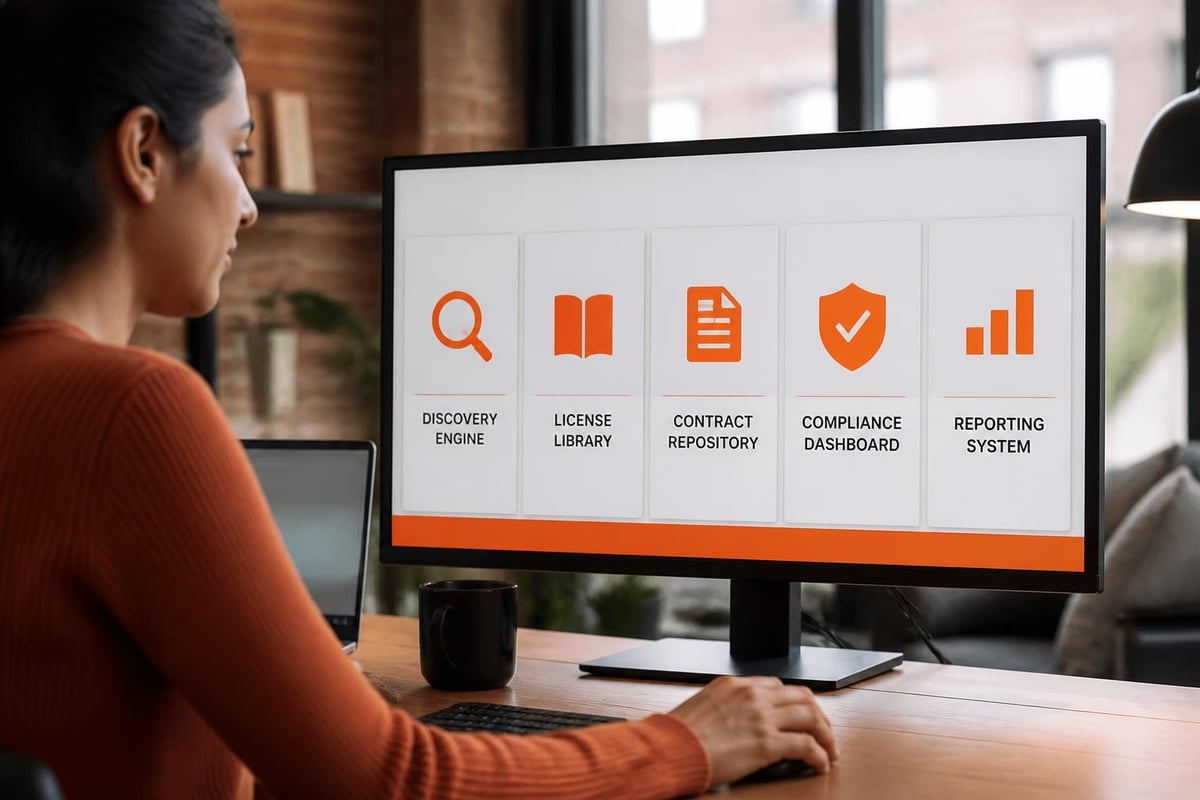
Contract and Entitlement Management
Centralized storage for all software contracts, purchase orders, and entitlement documents is essential. The system should track:
- Contract start and end dates
- Renewal terms and costs
- Maintenance and support coverage
- License metrics and quantities
- Vendor contact information
This contract repository becomes the single source of truth during audits, renewals, and budget planning cycles.
Audit Defense and Compliance Reporting
When vendors initiate audits, software asset management software provides the documentation needed to demonstrate compliance. Key capabilities include:
- Audit snapshots that freeze inventory data at specific points in time
- Compliance position reports showing license consumption against entitlements
- Historical tracking of installation and uninstallation events
- Evidence packages with supporting purchase documentation
- Gap remediation tracking to demonstrate correction of non-compliance
Organizations with robust SAM platforms navigate audits with significantly lower financial exposure and faster resolution timelines.
Financial Optimization Tools
Software asset management software identifies cost-saving opportunities through:
- Unused license identification for harvesting or retirement
- Shelfware detection (purchased but never installed)
- Edition downgrade opportunities (enterprise to standard)
- Consolidation scenarios (multiple tools serving same function)
- True-up cost projections before renewal deadlines
These optimization features typically deliver ROI within 6-12 months of implementation.
What Are Common Implementation Mistakes with Software Asset Management Software?
Organizations frequently encounter preventable challenges when deploying software asset management software. Understanding these mistakes accelerates time-to-value and prevents costly gaps.
Incomplete Discovery Coverage
Mistake: Deploying discovery agents only to managed endpoints while excluding cloud environments, contractor devices, or isolated networks.
Impact: Compliance reports show inaccurate license positions, creating false confidence that collapses during audits.
Solution: Map all IT environments before deployment and ensure discovery reaches every location where software might exist. Include cloud subscriptions through API integrations rather than agent-based scanning.
Treating SAM as a One-Time Project
Mistake: Implementing the software, running initial reports, then allowing the system to stagnate without ongoing maintenance.
Impact: Discovery rules become outdated as new software versions release. License reconciliation drifts from accuracy as contracts renew with changed terms.
Solution: Establish recurring processes for updating discovery signatures, refreshing license rules, and validating contract data quarterly. Assign dedicated SAM staff responsible for platform maintenance.
Ignoring Process Development
Mistake: Installing software asset management software without defining workflows for software requests, approvals, and lifecycle management.
Impact: The platform contains data but drives no behavioral change. Employees continue installing software outside approved channels.
Solution: Design and enforce request workflows that route through the SAM platform. Integrate with procurement to prevent software purchases without SAM team approval. Workflow automation software can streamline these approval chains.
Poor Data Quality in Contract Repository
Mistake: Entering incomplete contract information or failing to update renewal terms.
Impact: License reconciliation produces false positives when the system doesn't know about recent purchases or changed metrics.
Solution: Conduct a complete contract inventory before go-live. Establish a single point of contact who receives all software purchase confirmations and updates the SAM system within 48 hours.
Lack of Integration with Related Systems
Mistake: Running software asset management software as an isolated tool disconnected from procurement, ITSM, or financial systems.
Impact: Manual data entry creates duplicate work and synchronization errors. Teams work from different versions of asset data.
Solution: Implement bidirectional integrations with procurement (purchase orders), ITSM (asset records), and finance (cost allocation). Modern platforms offer pre-built connectors for major enterprise systems.
How Do Organizations Measure ROI from Software Asset Management Software?
Calculating return on investment from software asset management software requires tracking both hard cost savings and softer efficiency gains.
Direct Cost Avoidance
Organizations measure immediate financial impact through:
License harvesting: Reclaiming unused licenses from departing employees or unused installations generates direct savings. A 5,000-employee organization typically harvests $200,000-500,000 in annual license value.
Shelfware elimination: Identifying purchased but never-deployed licenses prevents waste in future renewals. Average shelfware rates range from 15-25% of software portfolios.
Audit penalty avoidance: SAM platforms that identify compliance gaps before vendor audits prevent penalties. Single-vendor audit settlements often exceed $500,000 for mid-size organizations.
Optimized renewals: Usage data enables negotiation from positions of knowledge. Organizations document which licenses see active use versus those suitable for non-renewal or downgrade.
| ROI Metric | Typical Annual Value | Measurement Method |
|---|---|---|
| License harvesting | $200K-500K | Reclaimed license count × unit price |
| Shelfware reduction | 15-25% of spend | Unused purchases prevented |
| Audit penalty avoidance | $100K-1M+ | Historical audit costs vs. current exposure |
| Negotiation leverage | 10-20% of renewal | Documented savings on renewals |
Operational Efficiency Gains
Software asset management software reduces labor costs through automation:
- Request processing time: Automated workflows reduce manual review from 30-60 minutes per request to 5-10 minutes
- Audit preparation: Platforms generate compliance reports in hours versus weeks of manual data gathering
- Budget planning: Real-time spend visibility eliminates monthly reconciliation spreadsheets
- Vendor management: Centralized contract data reduces time spent locating purchase documentation
A SAM team of 3-4 people can manage software portfolios that would otherwise require 8-10 people using manual processes.
Risk Reduction Value
While harder to quantify, compliance risk reduction carries significant value:
- Reduced probability of audit failures and associated penalties
- Decreased legal exposure from unlicensed software use
- Lower security risk from unmanaged software installations
- Improved vendor relationship management through demonstrated compliance
Organizations often assign a dollar value to risk reduction based on historical audit costs or insurance actuarial models. Frameworks like KPMG’s SAM maturity assessment help quantify risk levels at different maturity stages.
Time-to-Value Metrics
Most organizations achieve positive ROI within:
- 90 days: Initial license harvesting and shelfware identification
- 6 months: First major renewal negotiated with usage data
- 12 months: Full process automation and team efficiency gains realized
The payback period for software asset management software typically ranges from 6-18 months depending on portfolio size and license complexity.
What Integration Points Matter Most for Software Asset Management Software?
Software asset management software delivers maximum value when integrated into the broader IT ecosystem rather than operating as a standalone system.
IT Service Management (ITSM) Platforms
Bidirectional integration between SAM and ITSM systems like ServiceNow or Jira Service Management creates a unified asset view:
- Hardware CI records from ITSM link to software installations in SAM
- User accounts synchronize to associate licenses with specific employees
- Software requests submitted through ITSM catalogs trigger SAM approval workflows
- Change management triggers in ITSM update SAM when systems are decommissioned
This integration eliminates duplicate asset databases and ensures teams reference consistent data. Organizations managing service delivery management benefit from this consolidated view.
Procurement and Financial Systems
Connecting software asset management software to ERP and procurement platforms automates the purchase-to-deployment lifecycle:
- Purchase requisitions for software require SAM approval before proceeding
- Purchase orders automatically create contract records in SAM
- Invoice matching validates that billing aligns with known contracts
- Cost allocation distributes software expenses to appropriate departments or projects
Financial integration also enables chargeback models where business units pay for their actual software consumption rather than IT absorbing all costs centrally.
Identity and Access Management (IAM)
Integration with identity providers (Active Directory, Azure AD, Okta) provides:
- User lifecycle automation: New hire provisioning triggers license assignment; terminations trigger reclamation
- SaaS discovery: API connections to SSO providers reveal shadow IT SaaS subscriptions
- Access rights mapping: Understanding who can use which applications
- Compliance validation: Ensuring licensed users match actual access permissions
IAM integration is especially critical for SaaS license management, where user provisioning directly consumes license entitlements.
Cloud Management Platforms
As workloads migrate to cloud infrastructure, integration with AWS, Azure, and GCP management tools becomes essential:
- Instance inventory: Discovering software running on cloud VMs
- License mobility tracking: Understanding which on-premises licenses transferred to cloud
- Reserved instance optimization: Coordinating software licenses with compute reservations
- Cost allocation: Mapping software costs to cloud cost centers
Cloud integration ensures that software asset management software maintains visibility as organizations adopt hybrid and multi-cloud architectures, an area where Deloitte’s cyber and ITAM blueprint provides strategic guidance.
Security Tools
Connecting SAM platforms with vulnerability scanners and endpoint protection creates security benefits:
- Patch status visibility: Identifying which installed software versions have known vulnerabilities
- Unsupported software alerts: Flagging applications past end-of-support dates
- Unauthorized software detection: Cross-referencing discovered applications against approved lists
- License compliance as security control: Per CIS security controls, SAM is a foundational security practice
How Should Organizations Select Software Asset Management Software?
Choosing the right platform requires evaluating technical capabilities against organizational requirements and existing infrastructure.
Assessment of Current State
Before evaluating vendors, document:
Software portfolio size and complexity:
- Number of unique applications (typically 200-2,000+ for mid-to-large enterprises)
- Mix of on-premises versus SaaS
- Concentration of spend (often 80% of cost in top 10-20 vendors)
- Audit history and compliance pain points
IT environment characteristics:
- Operating system diversity (Windows-dominant versus mixed)
- Cloud adoption stage (early migration versus cloud-first)
- Geographic distribution (single location versus global)
- Security constraints (air-gapped networks, compliance requirements)
Organizational maturity:
- Existing SAM processes (ad hoc versus formalized)
- Team size and expertise
- Executive sponsorship level
- Integration requirements with other platforms
This assessment clarifies which platform capabilities are essential versus nice-to-have.
Vendor Evaluation Criteria
Score platforms across these dimensions:
Discovery accuracy and coverage:
- Test discovery against a known environment subset
- Verify cloud and SaaS discovery capabilities
- Assess container and mobile device support
- Evaluate update frequency for discovery signatures
License library completeness:
- Review coverage of your top 20 software vendors
- Validate rule accuracy for complex publishers (Oracle, IBM, Microsoft)
- Understand update process when licensing terms change
- Check for industry-specific applications relevant to your sector
Reporting and analytics:
- Evaluate pre-built report templates
- Assess custom report creation difficulty
- Review dashboard configurability
- Validate data export options for external analysis
Workflow and automation:
- Test request/approval workflow configuration
- Evaluate integration options with existing systems
- Assess alert and notification capabilities
- Review API documentation for custom automation
Vendor viability:
- Evaluate vendor financial stability and market position
- Review customer references in similar industries
- Assess training and support offerings
- Understand product roadmap alignment with your needs
Build Versus Buy Decision
Some organizations with specialized requirements or significant development resources consider building custom software asset management software. This decision requires honest assessment of:
Build advantages:
- Perfect alignment to unique business processes
- Complete control over features and roadmap
- No per-seat licensing costs
- Potential integration advantages with proprietary systems
Build challenges:
- 12-24 month development timeline before initial value
- Ongoing maintenance burden (discovery signatures, license rules)
- Inability to leverage vendor-specific license knowledge
- Lack of audit defense expertise and documentation
For most organizations, commercial software asset management software delivers faster time-to-value and lower total cost of ownership. Custom development makes sense primarily when managing highly specialized environments or when SAM represents a competitive differentiator.
Organizations seeking custom solutions that integrate SAM capabilities into broader business systems can work with development teams like Brytend to build tailored platforms that embed asset management within industry-specific workflows.

Proof of Concept Best Practices
Run structured POCs with finalists:
- Define success metrics: Establish measurable criteria (discovery accuracy %, time to generate compliance report, etc.)
- Use real data: Test against actual contract documents and a representative network segment
- Involve end users: Include SAM analysts, procurement staff, and IT administrators in evaluation
- Time-box the evaluation: 30-45 days provides sufficient assessment without analysis paralysis
- Document findings: Create scoring matrices that enable objective comparison
The POC should validate not just feature presence but usability and integration feasibility in your specific environment.

What Does Successful Software Asset Management Software Implementation Look Like?
Effective implementation follows a structured approach that combines technology deployment with process development and organizational change management.
Phase 1: Foundation (Weeks 1-4)
Discovery deployment:
- Install agents or configure agentless scanning for all in-scope environments
- Validate discovery accuracy against known software installations
- Tune discovery schedules to balance freshness with network impact
- Document discovery blind spots for future remediation
Contract data migration:
- Inventory all software contracts, purchase orders, and agreements
- Extract key data points (vendor, product, metrics, quantities, dates, costs)
- Load contract data into SAM platform
- Validate data accuracy through sample spot-checks
User and role configuration:
- Define access levels for SAM administrators, analysts, and stakeholders
- Configure role-based permissions aligned to responsibilities
- Establish naming conventions and data standards
- Create initial user accounts and assign roles
Phase 2: Reconciliation and Baselining (Weeks 5-8)
License position analysis:
- Run reconciliation for top vendors by spend
- Identify immediate compliance gaps requiring remediation
- Document optimization opportunities (unused licenses, edition downgrades)
- Create baseline compliance metrics for ongoing tracking
Process documentation:
- Document software request and approval workflows
- Define license reclamation procedures
- Establish audit defense playbooks
- Create run books for common SAM tasks
Stakeholder communication:
- Present initial findings to executive sponsors
- Share compliance status with affected business units
- Communicate process changes to end users
- Establish regular reporting cadence (monthly scorecards)
Phase 3: Workflow Automation (Weeks 9-12)
Request/approval automation:
- Configure software request forms in SAM platform
- Map approval routing based on cost, risk, or department
- Integrate with procurement for automated PO creation
- Implement automated license assignment workflows
Compliance monitoring:
- Set up automated alerts for compliance threshold breaches
- Configure scheduled reports for SAM team and stakeholders
- Establish license harvesting workflows for terminated users
- Implement true-up tracking for enterprise agreements
Integration deployment:
- Connect SAM platform to ITSM for asset synchronization
- Integrate with identity provider for user lifecycle automation
- Link to procurement system for purchase automation
- Establish data feeds to/from finance for cost allocation
Phase 4: Optimization and Maturity (Ongoing)
Continuous improvement:
- Quarterly review of license rules for accuracy
- Monthly assessment of discovery coverage gaps
- Ongoing refinement of workflow efficiency
- Regular vendor management activities (QBRs, renewals)
Expansion:
- Extend discovery to previously excluded environments
- Add new vendor-specific license rules as software is adopted
- Implement advanced analytics (usage trending, renewal forecasting)
- Develop self-service portals for software requests
Organizations following this phased approach typically achieve operational maturity within 6-9 months. Resources from IAITAM provide additional implementation guidance and best practices aligned to industry standards.
What Role Does Software Asset Management Software Play in Broader IT Asset Management?
Software asset management software represents one component of comprehensive IT Asset Management (ITAM) programs that span hardware, software, cloud services, and contracts.
SAM Within the ITAM Framework
Modern ITAM encompasses:
- Hardware asset management: Physical and virtual infrastructure tracking
- Software asset management: Application licenses and usage
- Cloud asset management: IaaS, PaaS, and SaaS subscriptions
- Mobile device management: Smartphones, tablets, and IoT devices
- Contract and vendor management: Agreements spanning all asset categories
Software asset management software provides the specialized capabilities needed for software licensing complexity that generic asset management tools cannot adequately address. However, SAM platforms must integrate with broader ITAM tools to provide complete visibility.
Data Flow Between SAM and ITAM Systems
Integration creates bidirectional data exchange:
From ITAM to SAM:
- Hardware configuration data (processor counts, virtualization details)
- User assignment and location information
- Device lifecycle status (active, in storage, retired)
- Maintenance and warranty coverage
From SAM to ITAM:
- Installed software inventory per device
- License consumption and compliance status
- Software costs allocated to hardware assets
- Application usage and performance data
This integrated view enables analysis impossible with isolated systems, such as determining total cost of ownership (hardware + software + support) for specific business applications.
Alignment with Compliance Programs
Software asset management software supports multiple compliance objectives:
License compliance: Meeting vendor contractual obligations to avoid audit penalties
Security compliance: Identifying unsupported or vulnerable software versions as required by frameworks like SOC 2, ISO 27001, or NIST
Financial compliance: Accurate software expense reporting for financial audits and SOX controls
Regulatory compliance: Software inventory documentation for industry-specific regulations (HIPAA, PCI-DSS, GDPR)
Organizations with mature compliance monitoring software programs integrate SAM data into broader compliance dashboards that provide unified risk visibility.
Strategic Value Beyond Compliance
While compliance drives initial SAM adoption, mature programs deliver strategic value:
Technology standardization: Data on software proliferation informs standardization initiatives that reduce complexity and improve supportability
M&A due diligence: Software asset inventories and compliance positions are critical data points during acquisitions or divestitures
Cloud migration planning: Understanding current software deployment patterns and licensing terms informs cloud strategy and vendor negotiations
Sustainability reporting: Software asset data contributes to energy consumption and carbon footprint calculations for ESG initiatives
Organizations treating SAM as strategic asset intelligence rather than merely a compliance tool extract significantly greater value from their software asset management software investments.
Software asset management software has evolved from simple inventory tools into strategic platforms that drive compliance, optimize costs, and provide intelligence for technology decision-making. Organizations implementing these systems with defined processes, strong integration, and ongoing governance typically achieve ROI within their first year while building capabilities that scale with growing IT complexity. Whether you need to extend existing business systems with SAM capabilities or build integrated platforms that combine asset management with workflow automation, Brytend brings deep technical expertise in creating custom software solutions tailored to your specific operational requirements and compliance objectives.
Frequently Asked Questions
How is software asset management software different from IT asset management (ITAM)?
ITAM covers the full lifecycle of both hardware and software assets. Software asset management software is the software-specific subset — license compliance, usage tracking, and entitlement management. Many platforms cover both, but the underlying disciplines and expertise required differ.
What size organization needs dedicated SAM software?
Once an organization is managing licenses across more than a handful of major vendors, or has more than roughly 100 employees, the manual tracking approach typically breaks down and dedicated tooling starts paying for itself through recovered license waste alone.
Can SAM software fully prevent a failed vendor audit?
It significantly reduces risk by maintaining accurate, current compliance data, but audit outcomes also depend on correctly interpreting complex license agreements — SAM software is the data foundation, not a substitute for licensing expertise during an actual audit response.
Does SAM software cover cloud and SaaS subscriptions, or just traditional on-premise licenses?
Modern SAM platforms increasingly cover both, though the depth of SaaS-specific tracking varies significantly by vendor — worth confirming directly given how much software spend has shifted to subscription models.
Getting Started
The gap between what an organization thinks it owns in software licenses and what it actually owns, uses, and is compliant on is almost always larger than expected — and almost always costs real money until it’s made visible. Software asset management software turns that invisible waste and risk into a concrete, actionable dataset, typically justifying its own cost within the first optimization cycle for any organization managing software spend at meaningful scale.
Frequently Asked Questions About Software Asset Management Software
What is software asset management software?
Software asset management (SAM) software tracks which software licenses an organization owns, where they are installed, and how they are actually used, so teams can avoid both compliance risk from under-licensing and wasted spend from over-licensing.
Related: for general B2B asset management beyond software licenses, see asset management software for B2B operations; for IT hardware and technology asset tracking specifically, see asset management software IT.
How do you optimize software license costs?
Start with usage analysis: software unused for 90+ days is a candidate for reclamation, and comparing purchased editions against actual feature use often reveals opportunities to downgrade over-provisioned seats without losing needed capability.
How do you prepare for a software vendor audit?
Maintain audit-ready documentation continuously rather than scrambling when a notice arrives: run internal reconciliation audits quarterly, keep purchase orders and entitlement records centralized, and be able to show that purchased license counts meet or exceed deployed installations for every product.