A fire extinguisher inspection is a regular check that makes sure every extinguisher is in its place, fully charged, undamaged and ready to use. In practice it has three levels: a quick visual inspection every month, a thorough maintenance check by a qualified technician every year, and deeper work every few years, such as the 6-year internal examination and the 5- or 12-year hydrostatic test. Every inspection is recorded on the extinguisher tag or in a digital record, because a fire inspector, insurer or customer will ask for proof.
TL;DR:
- Monthly: a visual check of location, access, pressure gauge, pin and seal, label and visible damage
- Annually: full maintenance by a certified technician, with a new tag or label
- Every 6 years: internal examination of stored-pressure dry chemical extinguishers (NFPA 10)
- Every 5 or 12 years: hydrostatic pressure test of the extinguisher shell, depending on the type
- For fire safety companies the real work is planning hundreds of due dates across customers and sites, and keeping the proof
Fire extinguisher inspection is the recurring check, maintenance and record keeping that keeps portable extinguishers compliant and ready for a fire.
What Is a Fire Extinguisher Inspection?
A fire extinguisher inspection is a check of an extinguisher against a fixed list of points, at a fixed interval, with the result written down. The goal is simple: when someone pulls the pin during a fire, the extinguisher must work. Extinguishers can lose pressure, get knocked over, have their seals broken, be moved behind a pallet or get damaged by corrosion, and nobody notices until it is too late unless someone checks on schedule.
The rules differ per country, but the structure is the same almost everywhere:
- Inspection: a quick visual check that the extinguisher is available and will operate. In the US, NFPA 10 and OSHA require it at least monthly.
- Maintenance: a thorough examination by a trained technician, usually yearly, that may include opening, weighing and repairing the extinguisher.
- Internal examination and recharge: periodic opening of the extinguisher to check the inside and replace the agent.
- Hydrostatic testing: a pressure test of the cylinder or shell every 5 or 12 years, explained in our guide to hydrostatic testing.
In the US the main references are NFPA 10, the Standard for Portable Fire Extinguishers, and for workplaces OSHA 29 CFR 1910.157. In the UK the service of extinguishers follows BS 5306-3, and in the Netherlands NEN 2559. Always check which code your local fire authority enforces.
How Often Should Fire Extinguishers Be Inspected?
The table below shows the usual intervals under NFPA 10 and OSHA. Other countries use similar steps with their own names and intervals.
| Task | Interval | Who does it | What it covers |
|---|---|---|---|
| Visual inspection | Monthly (at least every 30 days) | Trained employee or owner | Location, access, gauge, pin and seal, label, visible damage, fullness |
| Annual maintenance | Every 12 months | Certified technician | Full external examination, mechanical parts, agent, new maintenance tag |
| Internal examination | Every 6 years for stored-pressure dry chemical extinguishers | Certified technician | Emptying, inspecting the inside, recharging |
| Hydrostatic test: water, foam, wet chemical, CO2 | Every 5 years | Certified test facility | Pressure test of the shell or cylinder |
| Hydrostatic test: stored-pressure dry chemical | Every 12 years | Certified test facility | Pressure test of the shell |
Some sites need more frequent checks. Extinguishers in vehicles, outdoor locations, construction sites or areas where they are often tampered with or exposed to corrosion are often inspected more often than once a month.

What Should a Monthly Fire Extinguisher Inspection Checklist Include?
The monthly inspection takes about a minute per extinguisher. NFPA 10 lists the points to check, and most monthly fire extinguisher inspection checklists follow it closely.
Step 1: Location and access
Check that the extinguisher is in its designated place, mounted correctly and not blocked or hidden by stock, furniture or vehicles. The sign above it should be visible.
Step 2: Instructions and label
The operating instructions on the nameplate must be legible and face outward, so anyone can read them in an emergency.
Step 3: Pin, seal and tamper indicator
The safety pin must be in place and the tamper seal unbroken. A broken seal can mean the extinguisher was partly discharged.
Step 4: Pressure and fullness
On stored-pressure models the gauge needle must be in the green (operable) range. Check fullness by weighing the extinguisher or by lifting it. CO2 extinguishers have no gauge and must be checked by weight.
Step 5: Physical condition
Look for dents, corrosion, leakage, a cracked or blocked hose or nozzle, and damaged wheels or hoses on wheeled units.
Step 6: Record the inspection
Initial and date the tag, or record the inspection digitally against the extinguisher’s serial number. If anything fails, take the extinguisher out of service and replace it with a working spare straight away.
What Happens During Annual Fire Extinguisher Maintenance?
Annual maintenance is a full service by a trained and, in many countries, certified technician. It goes further than the monthly check:
- Mechanical parts: valve, handle, pin, hose, nozzle and mounting bracket are checked and replaced where needed
- Extinguishing agent: the agent is checked by weight or, depending on the type, by opening the extinguisher
- Expelling means: the pressure or gas cartridge is checked
- Due dates: the technician checks whether the 6-year examination or the hydrostatic test is due
- Tag or label: a new maintenance tag or label records the month and year and who did the work
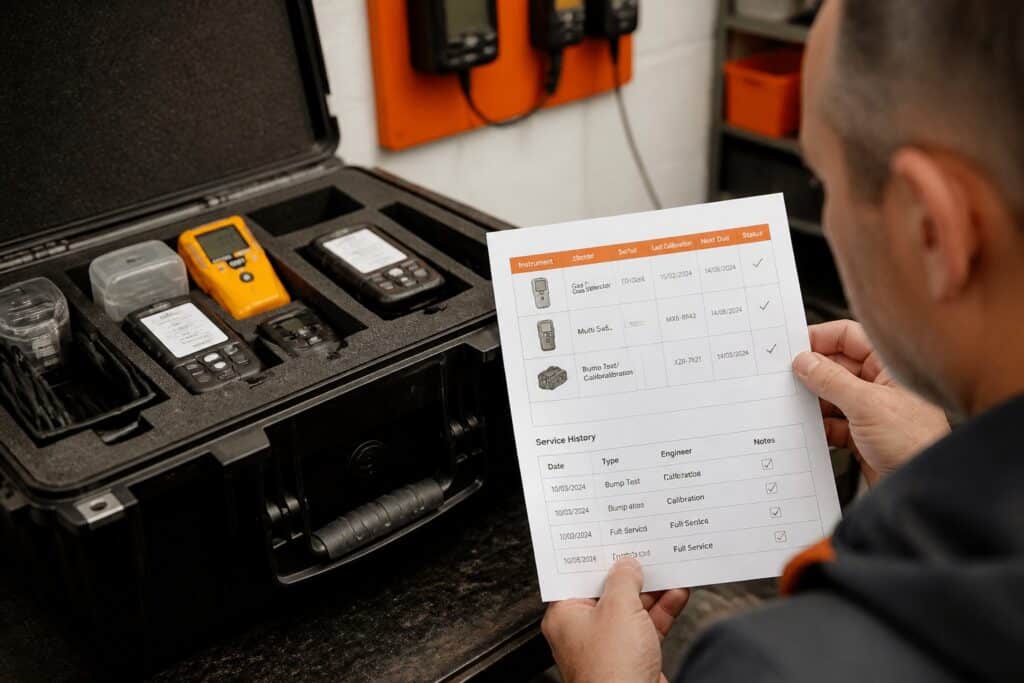
Under OSHA 1910.157 the employer must record the annual maintenance date and keep that record for one year after the last entry or for the life of the shell, whichever is shorter. Fire safety companies usually also give the customer a service report listing every extinguisher per location with the result.
What Are the 6-Year and Hydrostatic Test Requirements?
Stored-pressure dry chemical extinguishers that have a 12-year hydrostatic test interval must be emptied and given an internal examination every 6 years under NFPA 10 and OSHA. The extinguisher is discharged, the inside is checked, and it is recharged and resealed.
The hydrostatic test checks that the shell can still safely hold its pressure. Water, foam, wet chemical and CO2 extinguishers are tested every 5 years, most stored-pressure dry chemical extinguishers every 12 years. An extinguisher that fails, or that has obvious damage, corrosion or a damaged thread, is taken out of service. Our hydrostatic testing guide explains how the test works and what the markings mean.
What Do Fire Extinguisher Inspection Tags Mean?
The tag is the extinguisher’s public record. Anyone, including a fire inspector, can see at a glance when it was last serviced.
- Annual maintenance tag: shows the month and year of the last maintenance, and the name or licence of the technician or company
- Monthly inspection grid: many tags have a grid where each monthly inspection is initialled and dated
- Verification of service collar: a ring on the neck of the cylinder shows that the extinguisher was opened and recharged
- Hydrostatic test label: shows the date of the last hydrostatic test and the test facility
Tags work on site, but they do not help a fire safety company plan its work. To find every extinguisher due next month across 200 customer sites, the due dates also have to live in a system.
How Do Fire Safety Companies Manage Extinguisher Inspections?
A fire safety company may service tens of thousands of extinguishers for hundreds of customers. The inspection itself is quick; the effort is in the administration around it. Paper tags, spreadsheets and binders make it hard to plan routes, prove every inspection and catch the 6-year and hydrostatic due dates on time.
Register every extinguisher as a customer asset
Give each extinguisher one record with serial number, type, size, manufacturing date, customer, site and exact location, for example “Building B, floor 2, next to stairwell”. A QR code label links the physical extinguisher to that record, see QR code asset tracking.
Plan visits from due dates
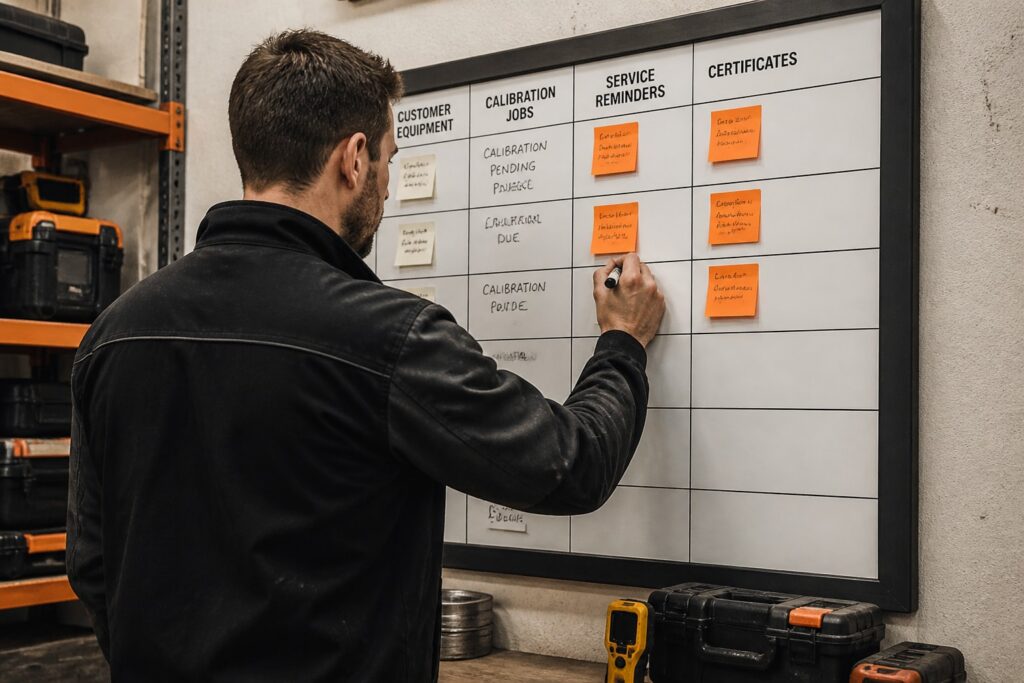
List the extinguishers due for annual maintenance, 6-year examination or hydrostatic test per customer and per month, and turn them into planned visits and work orders. Inspection management software sends reminders before anything becomes overdue.
Use a digital checklist on site
The technician scans the label, works through the checklist on a phone or tablet and records pass or fail with photos. Digital service forms make sure every point is checked in the same way by every technician.
Send the customer a report and keep the history
After the visit the customer receives one service report for the site, and every result stays on the extinguisher’s history. Replaced, condemned and recharged extinguishers are visible, and so are the follow-up quotes.
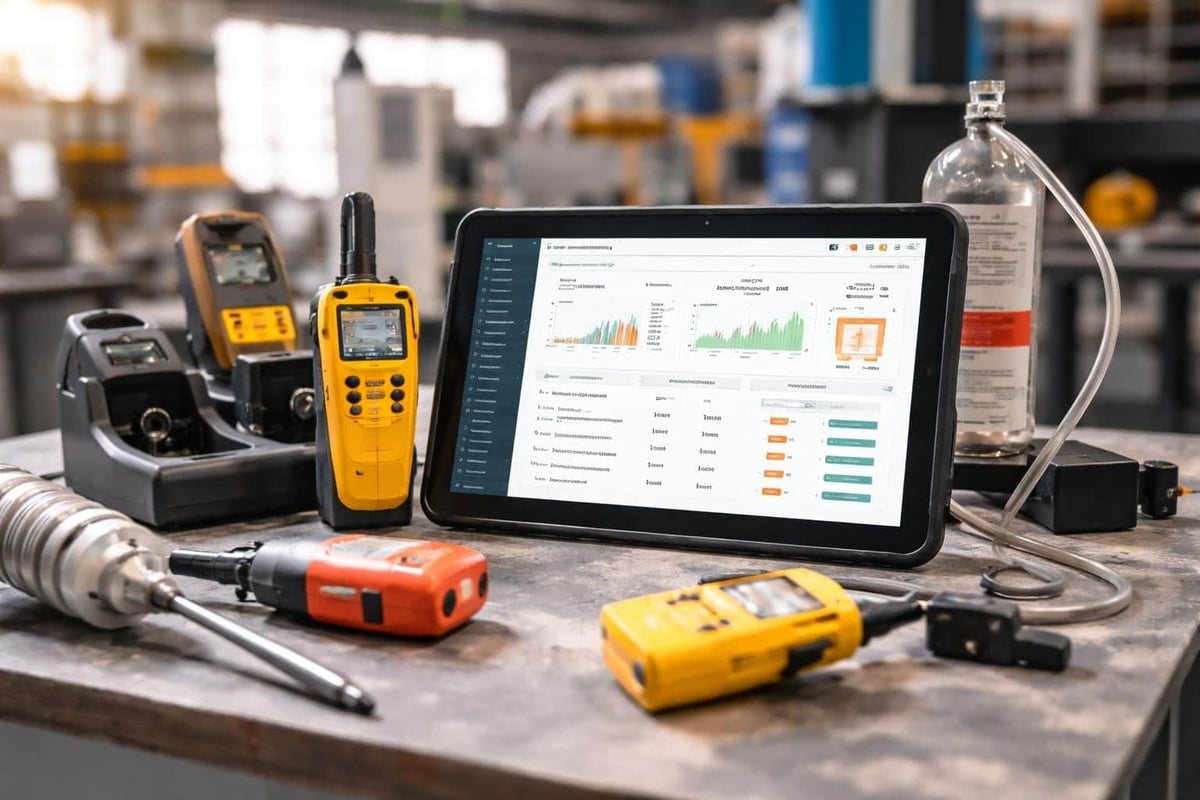
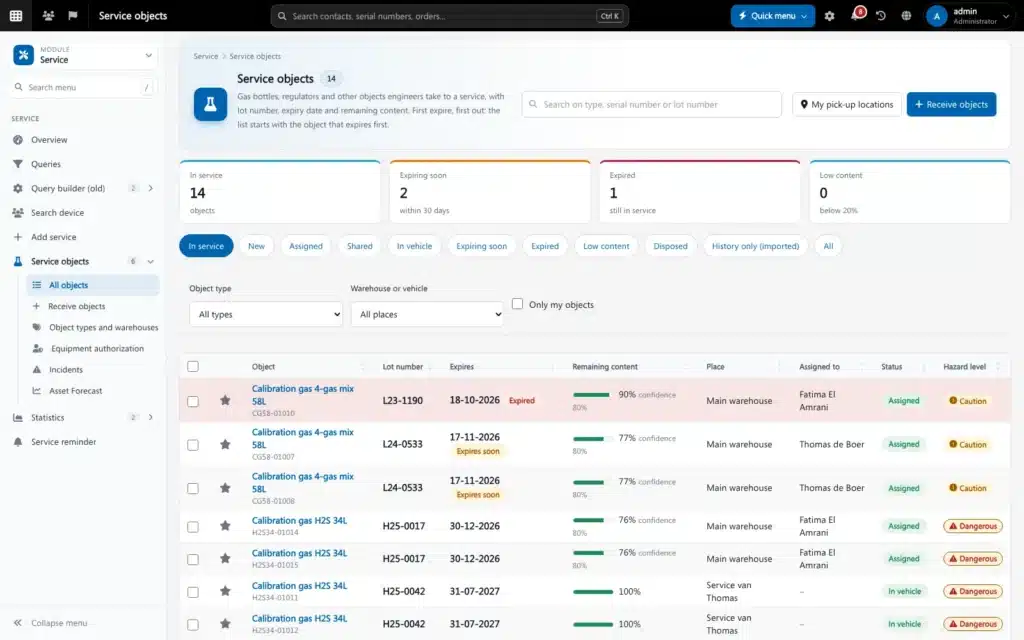
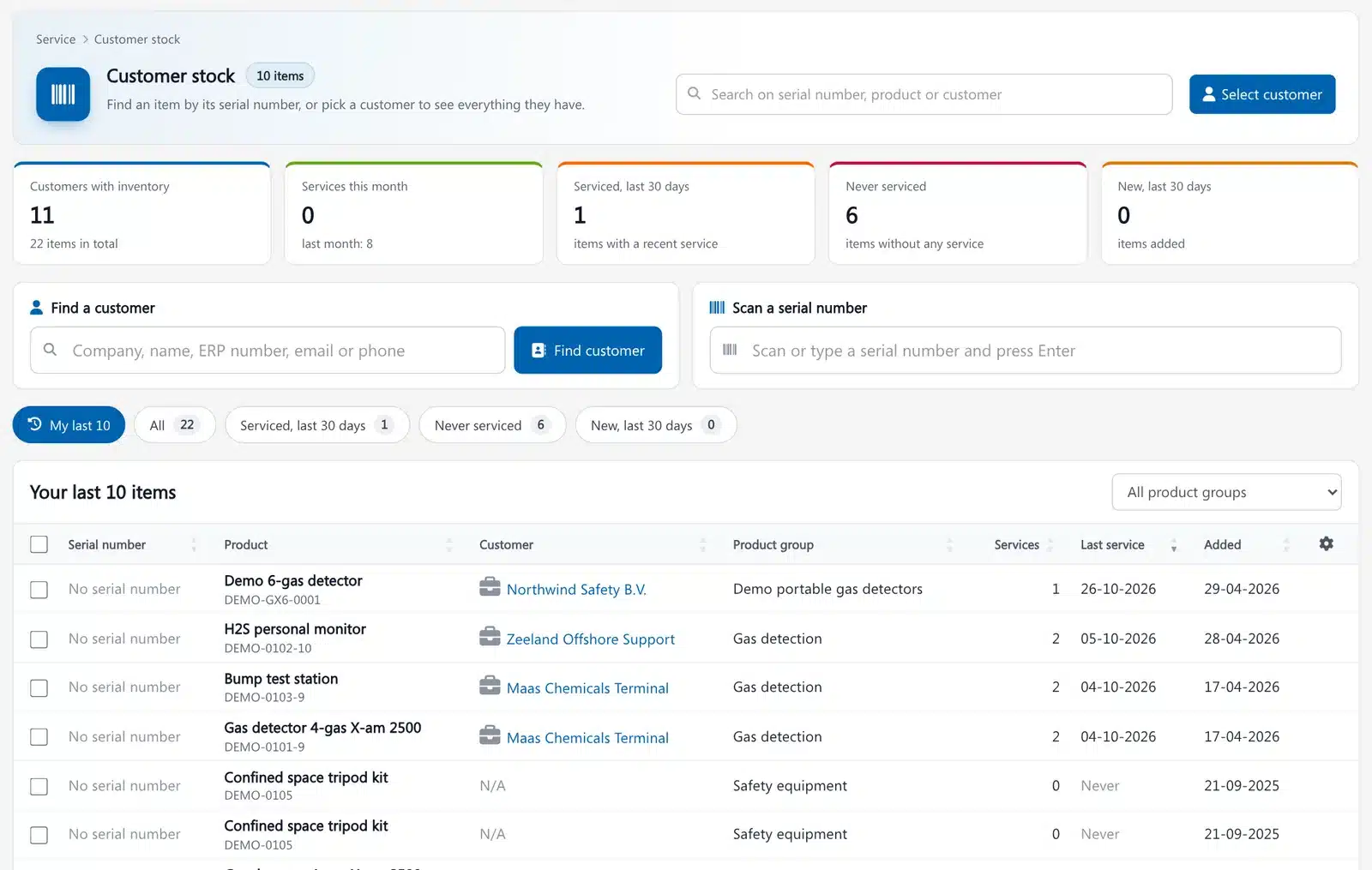
The Brytend Service and Inspections module keeps every extinguisher your customers own as customer stock with its serial number, location, service history and documents. Service reminders show which extinguishers are due, every inspection is a numbered service record with your own report template, and the next due date is set automatically. Breathing apparatus, gas detectors and cylinders can be managed in the same place, which is why fire and safety companies use Brytend for their whole service operation.
What Are Common Fire Extinguisher Inspection Mistakes?
- Skipping the monthly check: the annual service does not replace the monthly inspection, and most problems (blocked access, broken seals) are found monthly
- Trusting the gauge alone: a gauge can stick, and CO2 extinguishers have no gauge, so check the weight as well
- Missing the 6-year and hydrostatic dates: these come up rarely, so they are easy to forget without a system
- Extinguishers moved without updating the record: the location on file no longer matches reality
- No spare during repairs: an extinguisher taken away for service leaves a gap unless a replacement is placed
- Records that cannot be found: paper tags get lost or become unreadable, and a binder does not answer the question “show me all inspections for this site”
- Untrained inspectors: monthly checks are simple, but the person doing them should know what to look for, see our guide on training records
Frequently Asked Questions About Fire Extinguisher Inspection
How often does a fire extinguisher need to be inspected?
A fire extinguisher needs a quick visual inspection every month and a full maintenance check by a qualified technician once a year. On top of that, stored-pressure extinguishers get an internal examination every 6 years and a hydrostatic test every 5 or 12 years, depending on the type. Local rules can be stricter, so check the code your fire authority enforces.
Who can perform a monthly fire extinguisher inspection?
The monthly inspection is a visual check that a trained employee or the building owner can do. It covers location, access, the pressure gauge, seals, labels and visible damage. Annual maintenance, internal examinations and hydrostatic tests must be done by a certified or competent fire extinguisher technician.
What is on a fire extinguisher inspection checklist?
A monthly fire extinguisher inspection checklist covers the location and access, legible instructions facing outward, an intact safety pin and tamper seal, a pressure gauge in the green zone, fullness checked by weight or by lifting it, and no visible damage, corrosion, leakage or blocked nozzle. The inspector then initials and dates the tag or the digital record.
What does the tag on a fire extinguisher mean?
The tag shows when the extinguisher was last serviced and by whom. The annual maintenance tag records the month and year of the maintenance and the technician or company that did it, and many tags have a grid where monthly inspections are initialled. A missing or outdated tag is one of the first things a fire inspector notices.
How long must fire extinguisher inspection records be kept?
Under OSHA 29 CFR 1910.157 in the US, the annual maintenance record must be kept for one year after the last entry or for the life of the shell, whichever is shorter. NFPA 10 also requires records of monthly inspections. Many companies keep all records longer, because a full history makes audits and insurance claims easier.
What happens if a fire extinguisher fails inspection?
An extinguisher that fails inspection must be taken out of service and repaired, recharged or replaced right away, and a working spare should be put in its place. Common reasons are low pressure, a missing pin or seal, physical damage or corrosion, a blocked hose, or an overdue hydrostatic test.
Can fire extinguisher inspections be tracked digitally?
Yes. Many fire safety companies replace paper tags and binders with QR or barcode labels that open the extinguisher’s record on a phone or tablet. The technician fills in a digital checklist, the result and date are saved against the serial number, and the software lists which extinguishers are due next month per customer and site.
A fire extinguisher inspection takes a minute, but only if it actually happens every month, the annual maintenance is done on time, and the 6-year and hydrostatic dates are not forgotten. For building owners that is a matter of discipline; for fire safety companies it is thousands of due dates across hundreds of sites, each needing proof. If you service extinguishers, breathing apparatus or other safety equipment for your customers and want every asset, due date, checklist and report in one place, Brytend builds service software that does exactly that.